
Artist's Statement
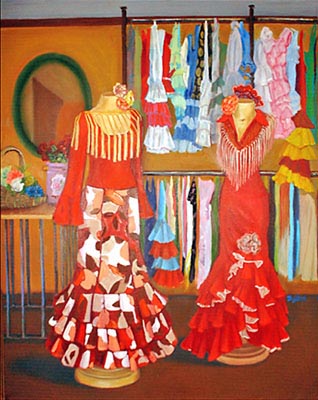
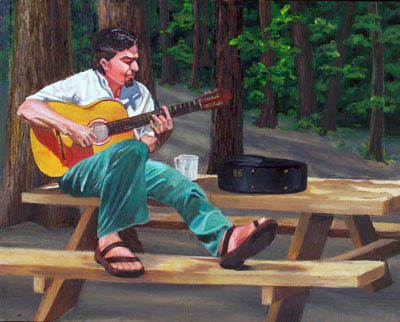
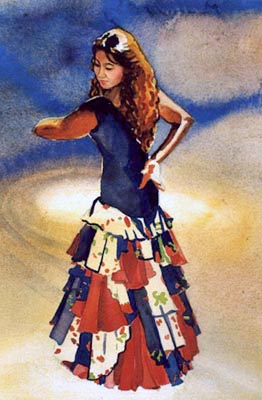
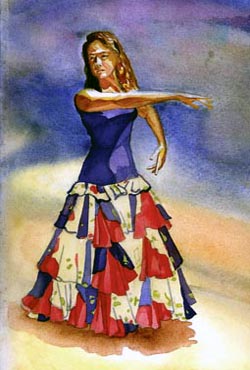
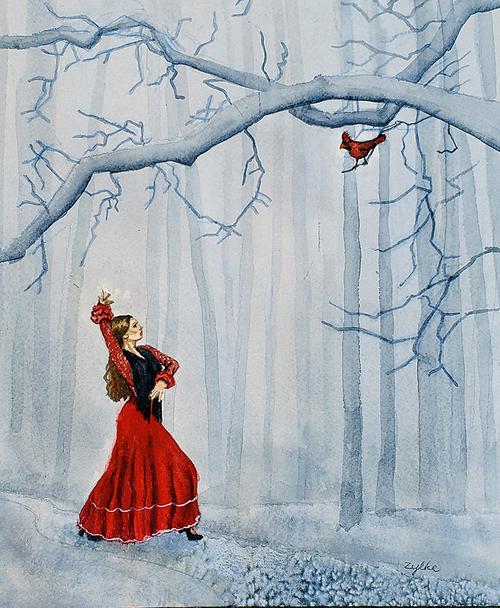
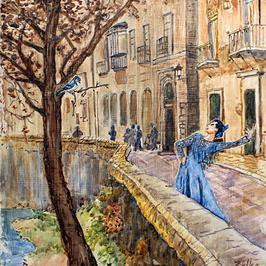
"I work in oils and watercolors, exploring the subjects that intrigue me the most: nature, time, and the creative process. My landscapes consist of scenes from my national and international travels. Some were painted on location, and some were derived from photographs I had taken specifically to be used for paintings. They tend toward an impressionistic style. Through them, I chronicle the intensity of that moment during which they are captured: the passage of light and atmosphere, the place where I stood painting and quiet while surrounded by the movement of people, breezes through the trees, and clouds passing the sun; the rise and fall of the day's heat; the feelings evoked during a rarified time, in a place where I am confronted by vistas or people that are far different from my everyday experience. My portraits of dancers and musicians reflect my ongoing interest in flamenco. They result from my contemplation of the differences between music's ephemerality and art's concreteness. A dancer's ability to take something as invisible as a sound and translate it into movement is my ongoing interest."
What the Critics are Saying
"The paintings of Jill Zylke (pronounced zill-key) are sunlit landscapes and portraits whose primary characteristics are soft harmonious color, lively brushwork and compositions which use carefully handled geometric perspective. The works have a refined, almost orientally subtle beauty. The note of ambiguity is an important element in the painting.
These paintings portray the peace and tranquility nature is capable of providing with perhaps a general hint of pantheistic forces which direct nature on an organized course. An analysis of the work of Ms. Zylke finds a thread of continuity in her landscape and figurative work; her faith in the life affirming aspects of nature. Beyond that, there is a hint of belief in compassionate forces, whatever they may be, beyond nature. Her art reaffirms the place for beauty as a sustaining and comforting force in our lives. It is full of imagination, lively brushwork, subtlety in the handling of composition, poetic light, and elegant refined color."
Robert Kameczura, Art Writer and Critic, Big Shoulders Magazine, Chicago Artists News
Biography
Jill Zylke, a Chicago-based visual artist, captures figures and landscapes in her oil and watercolor paintings.Through her art, she invites us to contemplate the roles, differences, and significance of varied cultural disciplines,including their social and psychological effects on participants and viewers. She transforms scenes into captivating visual narratives that provoke contemplation and connection. Her work is a fusion of traditional techniques and contemporary perspectives, inviting viewers to engage with the profound connection between humanity and the environment.In addition,she aims to ignite a conversation about the urgent need for global environmental
stewardship, reminding us of our responsibility to protect and preserve the landscapes that have captivated our hearts and souls.
Ms. Zylke's work has been shown in numerous solo exhibitions, as well as many group shows,such as the beverly Fine Art Center Baer Art Competition, the Chicago Artists' Coalition Art Open, the ARC Gallery Regional Exhibition,
and Around The Coyote. Her work has appeared in galleries such as Addington Gallery, Ann Nathan, ARC Gallery,the Chicago Cultural Center, Jackson Junge, Mars Gallery, 33 Contemporary, and the Koehnline Museum.she was A featured artist in the Revere Graphics and Enteron Group Calendars and has been interviewed on the television show Is It Art? in Voyage Chicago online magazine,the Chicago Art News,and Chicago Sun-Times newspapers.
Fine Art

Dance
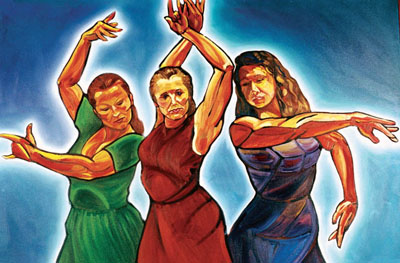
Dance/Flamenco